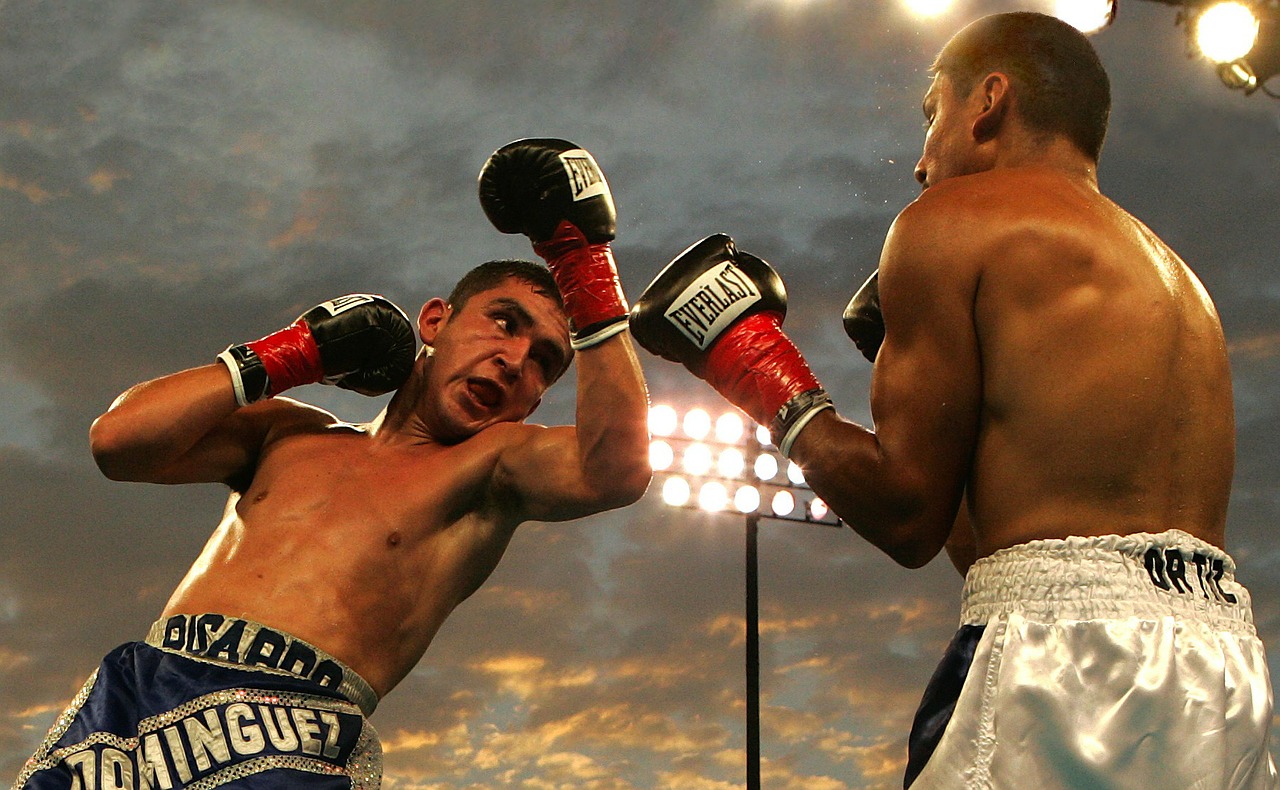
Boxing skills are absolutely essential for anyone who wants to compete in mixed martial arts. You simply cannot step into the ring or cage with the well rounded fighters of today if you are missing this important part of the mixed martial arts puzzle.
Nor can you simply take that piece of the puzzle and expect it to fit into your MMA game without a little bit of tweaking on your part.
Ideally you would have the expertise of a coach that knows both sports and knows how to integrate them together.
You can use this article as a supplement to the training you will receive from a qualified coach.
Let’s take a look at the difference between the way a boxer boxes and the way a MMA fighter boxes.
The main differences are…
- How to cover up and absorb punches to the head – The gloves that are used as a boxer are quite a bit bigger than the gloves used in MMA. This gives you a larger shield to hide behind when your opponent attacks. Also the impact the fighter receives is not transferred to the head as much with the large gloves of a boxer as it is with MMA gloves. So where as a boxer may cover up by putting his gloves directly in front of his face and letting the impact be absorbed by the gloves, a mixed martial artist needs to defend differently. The preferred cover up method for MMA is to use the forearms and elbows. For a straight punch the hands are placed palm down against the top of the forehead, which puts the forearms in the correct position in front of the face. For hooks, the palm of the hand is slid to the back of the head, which brings the entire outside of the arm into position to protect the side of the head.
- How to duck under punches – In a fight, a boxer will commonly duck under a punch by bending forward at the waist. In MMA your opponent is allowed to knee and/or kick you in the head. So if you duck a punch by bending at the waist while in a MMA fight, you could be asking for trouble. It is a much better idea to keep your body upright and bend your knees to duck under the attack. This will protect you from eating that unwanted knee to the face.
- Why you pinpoint your strikes – In both sports it is important to throw accurate strikes. If you hit a vulnerable area of an opponent’s body, you will cause more damage and that is the ultimate goal of throwing your strikes in both sports. But with the lighter MMA gloves on, there is one other reason to throw your punches accurately. They don’t offer your hand as much protection as a heavily padded glove does. If you miss your target and hit the forehead for example, it could result in a broken hand a lot easier than if you had larger gloves on. So when you throw your punches, aim.
- How hard of a punch you can take – A professional boxer wears gloves that are usually around 10 oz, but the gloves used in MMA are only 4 oz. This drastically changes how hard of a shot you can take without going down. Now this does not mean you should be passive and not engage the opponent out of fear of taking damage. It only makes the instruction all fighters are given “Protect yourself at all times” that much more important. Hit and don’t be hit.
Although there are many differences between how you would regularly box and how you would box in MMA, they do remain small differences. For the most part you can take the skills you learn as a boxer and directly apply them to mixed martial arts. There only needs to be a little tweaking.
Some things that are universal regardless of whether you are stepping into a ring to just box or stepping into a cage for a MMA fight are…
- Hands up and chin down – Always protect yourself by keeping your guard up. A chin tucked down next to your shoulder is a lot harder to hit than one that is sticking out.
- Circle to the opponent’s blindside – This ensures that you stay away from his power hand and/or power leg. It also gives you less weapons to deal with because he can only reach you with lead hand/leg attacks.
- Stay light on your feet – Mobility is vital for both kinds of fighter. This is what keeps you in range to strike and what keeps you out of range to not be struck. The ability to use your techniques effectively is largely determined by how good your footwork is. Staying mobile also makes it harder for your opponent to set up a planned attack.
- Throw your punches in combination – Very simple, one punch is easier to defend than two, three or four. It also makes it harder for you opponent to counter strike, because he is on the defensive.
- Punch with your whole body – By coordinating the movement of your body correctly, you can put the power of your entire mass behind each punch. This is done by using they legs to power the rotation of the hips and shoulders, which in turn puts more power into your arm and the punch.
- Be well conditioned – If you are in a fight and you run out of gas, whether you are a mixed martial artist, boxer, wrestler or submission wrestler, you will be finished. Literally.
This should give you a good start in learning the basics of boxing for mixed martial arts and in knowing how to tweak your training of this important art to better suit a MMA fight.
Would you like to learn about another important aspect of stand up fighting? If so, then visit our Thai boxing page.


[…] If you want to expand on the stand up skills that you learn in Muay Thai, visit the Boxing page. […]
how can i hit them without receiving too many hits myself
Hit them first
Mark, when striking an opponent, you have to work on getting back onto guard as quick as possible right after throwing. Another tool would be to work on countering your opponents strikes. One reason Chuck Liddell was caught by Jackson in their second fight was Chuck threw a hit to the body and didnt recover quick enough.
1. Hit someone by moving in an out so you can hit them and they cannot reach you.
2. Always move to avoid being an easy target
3. block punches and kicks
I have a dumb question:
The number system for boxing, as 1 is a jab 2 is a right cross…so is the command of “4” the same as doing 1,2 twice? In other words does 4 mean jab, cross, jab, cross? Or is it jab, cross, left hook, right hook?
In the same way is the command “3” jab, cross, jab….or jab, cross, left hook?
Tim in Toronto
Well this one move i learnt you run into the fight throw a combo like 112 or 221 etc than run back out than look for a opening and go again
Hey mark, The best way to hit them and not get hit is to keep your eyes on them, throw ur combo and move away while protecting ur self. Do this through most of the fight.
It’s important to keep moving.
Mark,
It depends on who you are fighting and what your style is. The universal approach to fitting is the stick and run. This is a good way to gage your opponent. Step in, throw a fast combo, and then get out quick. Keep moving.
You’re going to get hit. A lot. The point is to hit harder, faster and more often than your oppenent. If you can set him up for a submission while doing this you’re in good shape for a win.
Damn spellcheck. I meant to say “fighting” not fitting. You could try to fit someone while they fight you… but I don’t see that ending well.
mark to not get hit is to keep your mind open,think what your oppponient is thinking,say if you go 221 then move out the way and exspect him to come back with somthing similar.Een tho im only a begginer iv seen mosty my opponients do similar moves as i do,best way to keep them from hitting you the same way is find an opening and hit them back with either another punch or a kick to the face when their arms arnt directly infront of their face.Just my advise
hey man
1=jab
2=right hand(cross)
3=left hook
4=right uppercut
thats pretty much the standard.. everybody has different numbers for the punches. so for 1232 it would be jab.right.hook.right
I would suggest using a mauy thai leg kick with special attention in driving the hips through and downward following a combo. In every street fight I have been in this has worked well:) If you clash and go into the clinch pull the head down and shift there weight side to side and time in a few devastating knee’s (aka Sledge hammers) break the clinch with a quick elbow and over hand right or a hip toss. remember to protect your self at all times!!!!!
Hey
Im very interested im mixed martial arts so i wanna no…
will my skills as a amatuer wrestler help me?
and also
if a 4 is a right uppercut,is 5 a left uppercut?
cheerz
Ya, the part about hitting in the forehead, fought last november, got a boxers fracture in my hand, just recently healed. Hit the guy one time in the forhead/temple, and 2 more in the jaw and he was out lol
(From an orthodox stance)
1. Jab
2. Straight Right
3. Left Hook
4. Over hand Right
5. Left Uppercut
6. Right Uppercut
(There is no hook with you right or “power hand”)
For boxing, a great combo is a 1,6,3,4,1
For MMA, 1,6,5,4,3 or 1,6,4,6,4 (great to stuff shooters, Keep your lead hand high, it will protect you from those looping overhands)
Mark, the best way to not get hit, is keep your guard up no matter what. What you throw punches or kicks, keep a hand in sorta close so you can either parry or block the opponents stike. But honestly, your gonna get hit no matter what, just keep your mind on finishing the fight, before the other guy finishes the fight for you. Throw hard, fast, and with presicion and you should come out on top.